


Check if You Can Reduce Medications Safely With a Free AI Review

Many people take more medications than they need. Some drugs that were started for a good reason continue long after they stop providing benefit, and can even cause harm. The NowPatient Deprescribing Advisor is a free AI consultation that helps identify whether any of your medications may be candidates for safe reduction or withdrawal.
Using an AI chat interface trained on rigorous, evidence-based deprescribing protocols, the tool evaluates your medications and, where appropriate, generates a comprehensive report for your doctor. The report explains the clinical rationale and exact protocol needed to safely reduce or stop the medication*.
*IMPORTANT SAFETY NOTICE: Under NO circumstances should you STOP or WITHDRAW your medication until you have discussed the report with your doctor.
HOW IT WORKS
Common Questions About This Service


What is deprescribing?
Deprescribing is the safe and effective process of reducing or stopping medications that are no longer helpful or that may be causing harm. Medications are often started for a good reason, but sometimes they are continued long after they stop providing benefit — and may even cause adverse effects. Deprescribing involves slowly and carefully cutting down on unnecessary medications with the help of a healthcare professional.
Why is deprescribing important?
Many people, particularly older adults, take multiple medications at the same time. Some of these may no longer be necessary, may interact with other drugs, or may carry a higher risk of side effects than benefit. Deprescribing helps ensure every medication a person takes is still working in their best interest.
What are common examples of medications that might be deprescribed?
Some medications may be deprescribed because they provide no meaningful benefit — for example, certain stool softeners, supplements, and vitamins. Others may be deprescribed because they carry dangerous adverse effects or because long-term use can cause health problems.
Some medical conditions also do not need to be as tightly controlled with age — for example, it is possible to deprescribe some medications for diabetes, cholesterol, or high blood pressure when the clinical picture changes over time.
What are the benefits of deprescribing?
Taking fewer medications could help you feel better for several reasons. Deprescribing may:
Lower the number of medications you have to take every day
Save you or the health system money by reducing hospital admissions
Increase your ability to reliably take the medications that do provide benefits
Decrease the risk of dangerous adverse effects and improve your quality of life
Is it safe to deprescribe medications?
The final decision to deprescribe a medication must only be made by your supervising doctor — never by you alone. Your doctor may decide that some medications can be safely stopped immediately. Others need to be slowly decreased, or “tapered”, a bit at a time. Tapering helps your body adjust to not taking a medication, preventing withdrawal effects. The AI Deprescribing Advisor generates a report for your doctor that guides them on exactly how to do this safely.
What is the NowPatient AI Deprescribing Advisor?
The NowPatient AI Deprescribing Advisor is a free AI consultation tool built on a chat interface that has been highly trained on rigorous, evidence-based clinical deprescribing protocols. It communicates with you in natural language to evaluate whether any of your medications are suitable candidates for deprescribing.
If deprescribing is recommended, it generates a comprehensive report for your doctor explaining the clinical rationale and the exact protocol needed to safely reduce or stop the medication.
Is the AI Deprescribing Advisor free?
Yes. The AI Deprescribing Advisor is a free tool available to registered NowPatient users. If the consultation identifies a medication that may be suitable for deprescribing, it generates a comprehensive report at no cost.
How do I access the AI Deprescribing Advisor?
Follow these steps:
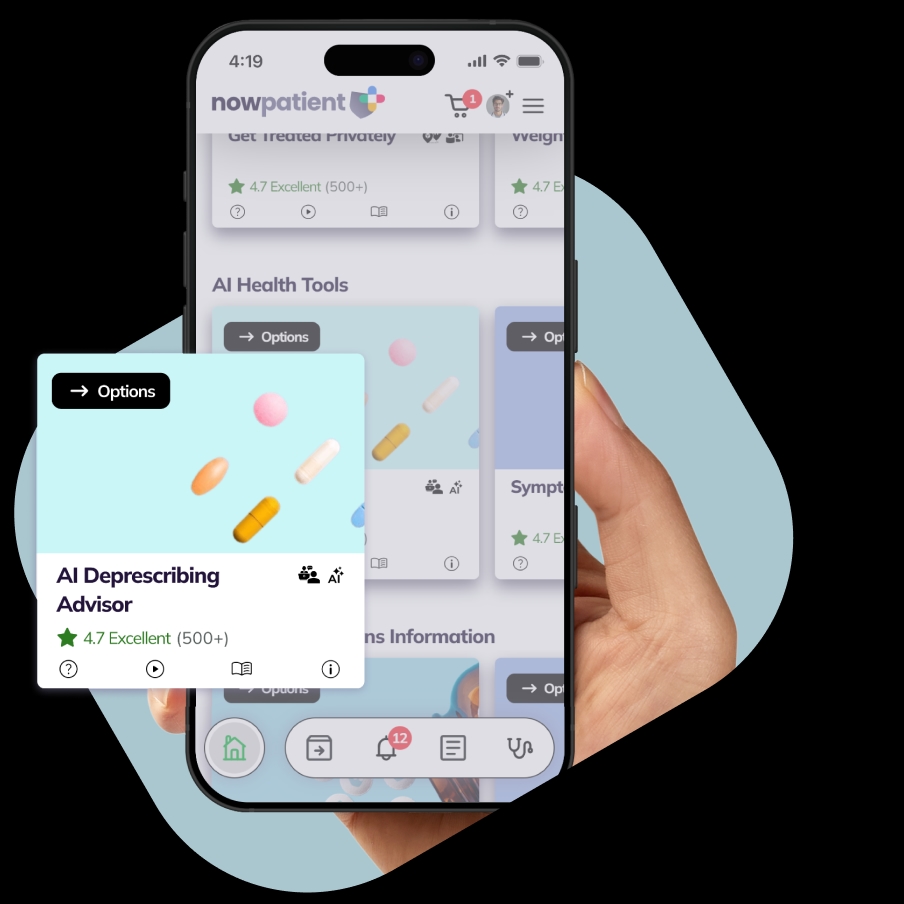
Navigate to the AI Deprescribing Advisor Service Card on your account homepage
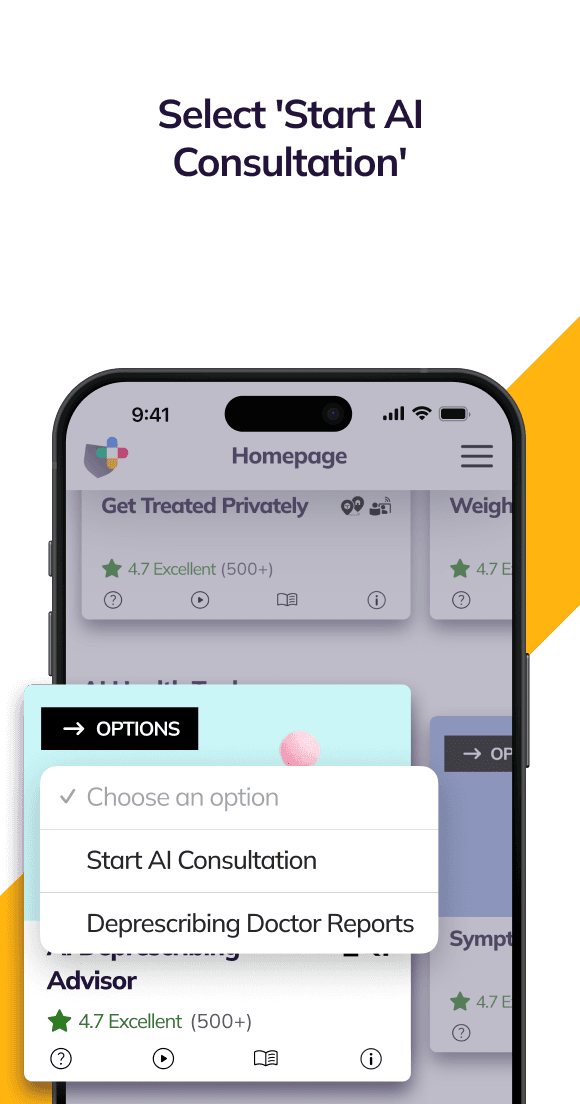
Select ‘Start AI Consultation’ from the Options menu
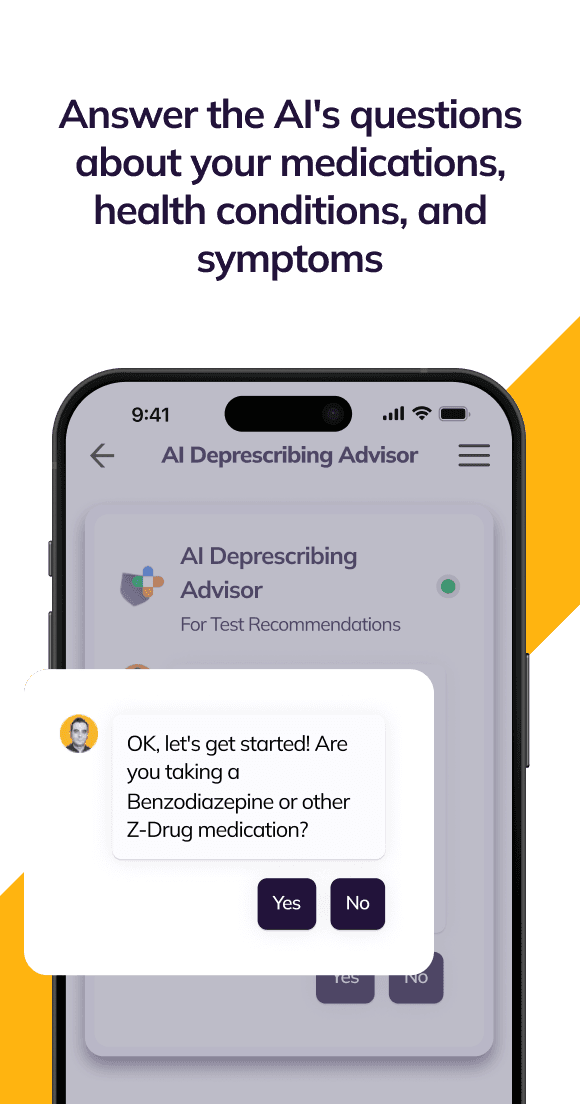
The AI Deprescribing Advisor will conduct a natural language consultation with you
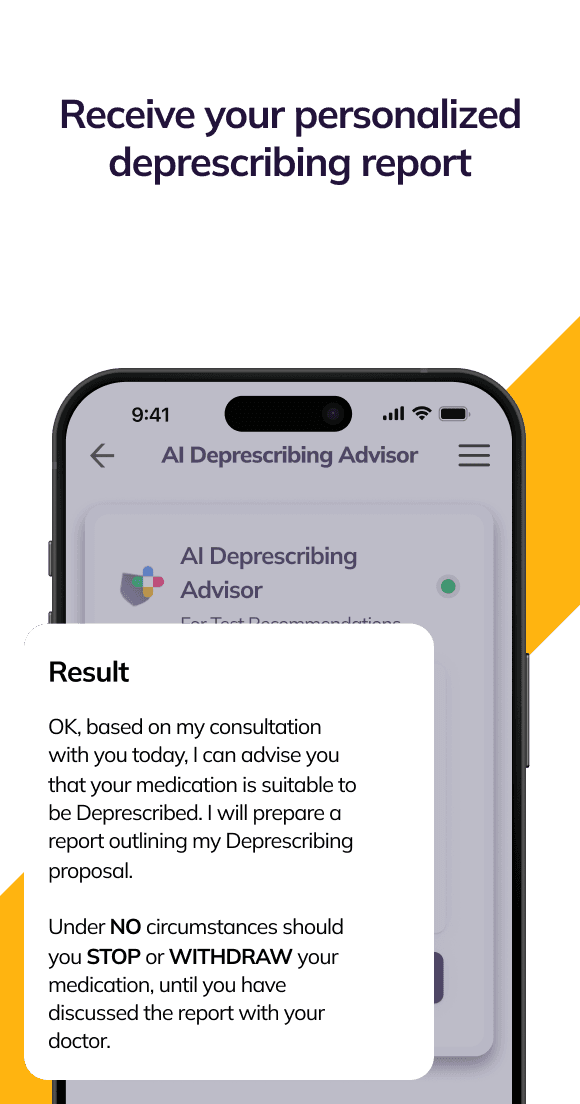
After the consultation, if one or more of your medications are found to be suitable candidates for deprescribing, the tool will advise you
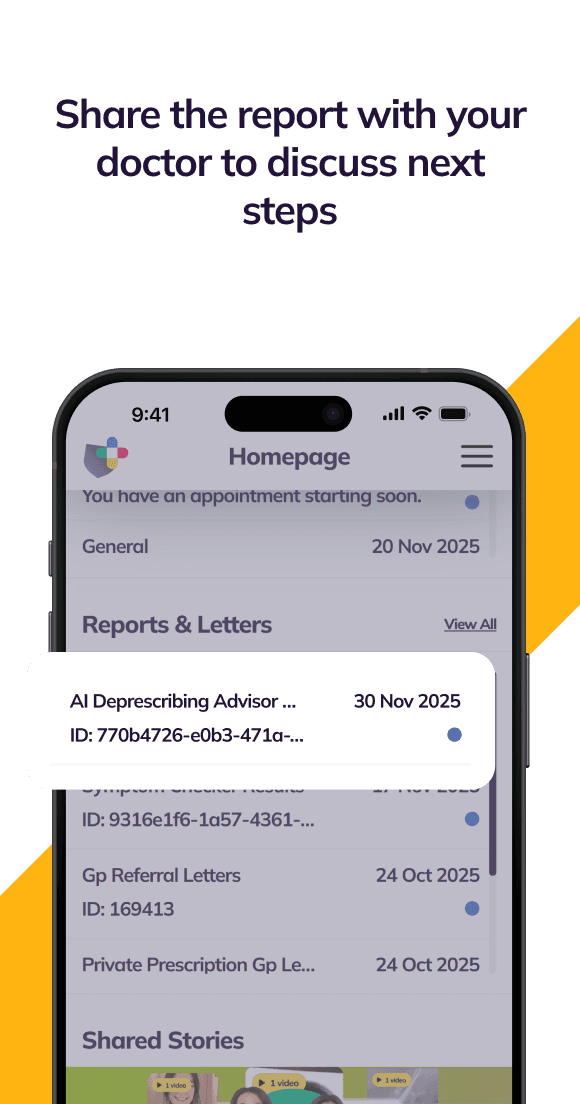
You will receive a notification when your report is ready — it will be available in your Documents folder
Share the report with your doctor to decide on next steps
What happens during the AI consultation?
The AI Deprescribing Advisor will ask you questions about your medications in natural language — much like a conversation. Based on your answers, it evaluates whether any of your medications meet the clinical criteria for deprescribing according to the relevant evidence-based guidelines. If a medication is found to be a suitable candidate, the tool generates a detailed report. If no medications meet the criteria, no report is generated.
Where will my report be available?
If the AI consultation identifies a medication suitable for deprescribing, you will receive a notification and the report will be available in your Documents folder on your NowPatient account. You can then share it with your doctor to discuss next steps.
What does the report contain?
The report provides your doctor with the evidence-based clinical rationale for the deprescribing recommendation and the specific protocol they should follow to safely reduce or withdraw the medication. It is a tool for your doctor to review and act on — not a prescription or an instruction for you to act on independently.
Can I stop my medication based on the report myself?
NO. Under NO circumstances should you STOP or WITHDRAW your medication until you have discussed the report with your doctor.
Is the AI Deprescribing Advisor safe to use?
Yes. The AI Deprescribing Advisor is classified as a Class I medical device under UK MDR 2002 regulations for its intended use. The tool generates recommendations and reports for your doctor — it does not make prescribing or deprescribing decisions. All decisions about whether and how to stop or reduce a medication must be made by your supervising doctor after reviewing your report.
Which medications can be assessed by the AI Deprescribing Advisor?
The AI Deprescribing Advisor covers the following medication classes:
Anticholinergic Medications
Proton Pump Inhibitors Medications
Anti-hyperglycemic Medications
Antipsychotic Medications
Benzodiazepine & Z-Drug Medications
Cholinesterase Inhibitor Medications & Memantine
Not all medications are covered by the evidence-based deprescribing protocols. If your medication does not fall within one of these classes, the tool will not be able to assess it.
Why are only these medication classes covered?
The AI Deprescribing Advisor is trained only on medication classes for which robust, peer-reviewed, evidence-based deprescribing guidelines exist — where the clinical evidence for safe deprescribing is strong enough to support specific recommendations. As new research and guidelines emerge, coverage may expand in the future.
What if my medication is not in one of the covered classes?
If your medication is not covered, the tool will not be able to generate a deprescribing report for it. If you have concerns about any medication you are taking that is not covered, speak directly with your doctor or pharmacist.
What clinical guidelines is the AI Deprescribing Advisor trained on?
The AI Deprescribing Advisor has been developed and trained on the following evidence-based deprescribing guidelines:
Anticholinergic (AC) Deprescribing
NSW Therapeutic Advisory Group, which is an initiative of NSW clinical pharmacologists & pharmacists.
Proton Pump Inhibitor (PPI) Deprescribing
B, Pottie K, Thompson W, Boghossian T, Pizzola L, Rashid FJ, et al. Deprescribing proton pump inhibitors. based clinical practice guideline. Can Fam Physician 2017;63:354-64 (Eng), e253-65 (Fr).
Antihyperglycemics Deprescribing
Farrell B, Black C, Thompson W, McCarthy L, Rojas-Fernandez C, Lochnan H, et al. Deprescribing antihyperglycemic agents in older persons. Evidence-based clinical practice guideline. Can Fam Physician 2017;63:832-43 (Eng), e452-65 (Fr).
Antipsychotic (AP) Deprescribing
Bjerre LM, Farrell B, Hogel M, Graham L, Lemay G, McCarthy L, et al. Deprescribing antipsychotics for behavioural and psychological symptoms of dementia and insomnia: Evidence-based clinical practice guideline. Can Fam Physician 2018;64:17-27 (Eng), e1-e12 (Fr).
Benzodiazepine & Z-Drug (BZRA) Deprescribing
Evidence-based clinical practice guideline for deprescribing benzodiazepine receptor agonists. Can Fam Physician 2018;64:339-51 (Eng), e209-24 (Fr).
Cholinesterase Inhibitor (ChEI) and Memantine Deprescribing
Reeve E, Farrell B, Thompson W, at al. Evidence-based Clinical Practice Guideline for Deprescribing Cholinesterase Inhibitors and Memantine. 2018. ISBN-13: 978-0-6482658-0-1.
Does the AI Deprescribing Advisor make its own medical judgements?
No. The tool applies established, peer-reviewed clinical deprescribing guidelines to evaluate your medication. It does not invent recommendations or draw conclusions beyond what the published evidence supports. All deprescribing decisions remain with your doctor.
Do I have to share the report with my doctor?
Yes. The report is specifically designed for your doctor. It contains clinical information and deprescribing protocol guidance intended for a healthcare professional to review and act on. You should not make any changes to your medication based on the report without first discussing it with your doctor.
What will my doctor do with the report?
Your doctor will review the deprescribing recommendation and the clinical rationale provided. Based on your full medical history and their clinical judgement, they will decide whether to follow the recommendation, adjust it, or advise against deprescribing in your particular case. The report is a starting point for a clinical conversation — not a directive.
What if my doctor disagrees with the deprescribing recommendation?
Your doctor has full clinical authority over your prescriptions and may have information about your health that the AI tool does not. If your doctor decides that deprescribing is not appropriate for you, follow their advice. The AI Deprescribing Advisor is a decision-support tool — the final decision always rests with your doctor.
Can I use the AI Deprescribing Advisor more than once for different medications?
Yes. You can use the AI Deprescribing Advisor to evaluate any medication that falls within one of the six covered medication classes. Discuss any reports generated with your doctor, who will consider the full picture of your medication regime before making any changes.
See how Deprescribing can help you benefit from dose reduction or stopping your medication altogether
Smooth, simple, seamless
Your Guide to Using the AI Deprescribing Advisor App Feature
- Step 1.
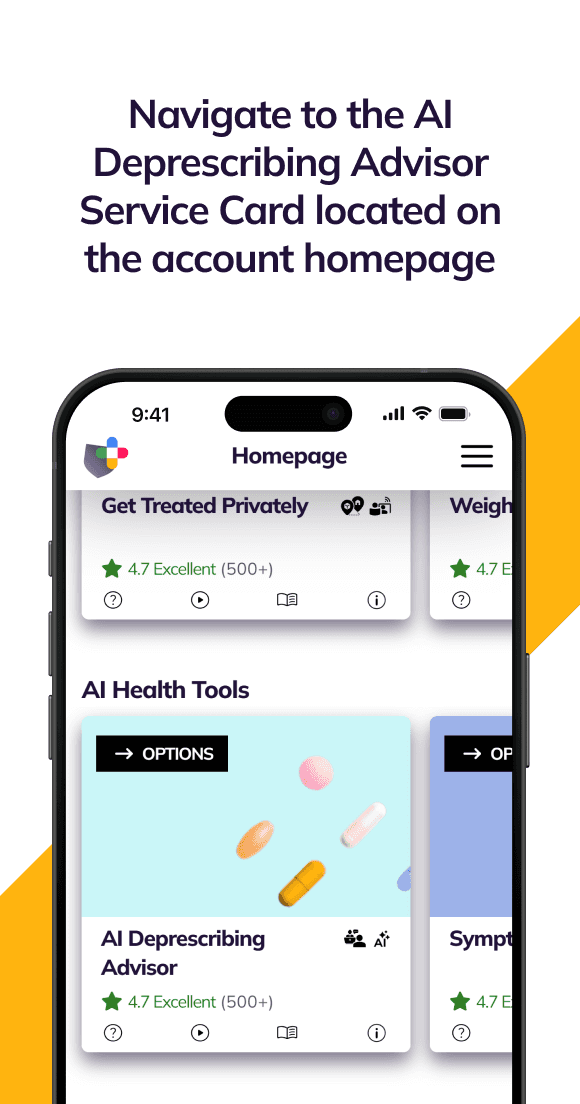
Navigate to the AI Deprescribing Advisor Service Card located on the account homepage
 1
1 - Step 2.
Select ‘Start AI Consultation’ from the actions
 2
2 - Step 3.
Answer the AI’s questions about your medications health conditions, and symptoms
 3
3 - Step 4.
Receive your personalised deprescribing report
 4
4 - Step 5.
Share the report with your Doctor to discuss next steps
 5
5
SERVICE GUIDE
How AI Deprescribing Advisor Works
What Is Deprescribing?
It is common for people to be prescribed many medications and also to take over-the-counter treatments, vitamins, or supplements. Medications are often started for a good reason, but sometimes they are continued when they are no longer helpful and may even cause adverse effects. Slowly and carefully cutting down on unnecessary medications with the help of a healthcare service is called deprescribing.
The final decision to deprescribe a medication must only be made by your supervising doctor. Your doctor may decide that some medications can be safely stopped immediately. Others need to be slowly decreased or “tapered” a bit at a time. Tapering helps your body adjust to not taking certain medications, preventing withdrawal effects.
How Does the AI Deprescribing Advisor Work?
The AI Deprescribing Advisor is a chat interface that has been highly trained on rigorous clinical deprescribing protocols. It communicates with you in natural language to evaluate whether your medication is a suitable candidate for deprescribing.
If the AI Deprescribing Advisor recommends that your medication is suitable for deprescribing, it will generate a report that you can share with your doctor. The report explains to your doctor the rationale for the deprescribing advice and what they need to do next to safely withdraw or stop your medication.
Important: Under NO circumstances should you STOP or WITHDRAW your medication until you have discussed the report with your doctor.
How to Use the AI Deprescribing Advisor
Using the AI Deprescribing Advisor is straightforward:
- Navigate to the AI Deprescribing Advisor Service Card, which is located on your account homepage
- Select ‘Start AI Consultation’ from the Options menu
- The AI Deprescribing Advisor will conduct a natural language consultation with you
- After the consultation, If the AI Deprescribing Advisor finds that one or more of the medications you take, are suitable candidates for deprescribing, It will advise you as such
- You will receive a notification if and when your report is ready. The report will be available in your Documents folder
- Share the report with your doctor to decide on the next steps
Which Medications Can Be Deprescribed?
Not all medications are covered by the evidence-based deprescribing protocols. The medication classes covered by the AI Deprescribing Advisor are:
- Anticholinergic Medications
- Proton Pump Inhibitors Medications
- Anti-hyperglycemic Medications
- Antipsychotic Medications
- Benzodiazepine & Z-Drug Medications
- Cholinesterase Inhibitor Medications & Memantine
The AI Deprescribing Advisor can help advise your doctor on how to reduce the dose or stop the affected medication because it is not providing substantial benefit, or because it carries considerable risk of negative health effects.
What Are the Benefits of Deprescribing?
Taking fewer medications could help you feel better for several reasons. Deprescribing may:
- Lower the number of medications you have to take every day
- Save you or the health system money by reducing hospital admissions
- Increase your ability to reliably take the medications that do provide benefits
- Decrease the risk of dangerous adverse effects and improve your quality of life
What Are Common Examples of Deprescribing?
Some medications may be deprescribed by a doctor because they do not provide any benefit, for example, stool softeners, certain supplements, and vitamins. Other medications may be deprescribed because they can have dangerous adverse effects, or because long-term use can lead to health problems.
Some medical conditions also do not need to be as tightly controlled with age. For example, it is possible to deprescribe some medications for diabetes, cholesterol, or high blood pressure when the clinical picture changes over time.
What Are the Evidence Bases for Each Deprescribing Protocol?
The AI Deprescribing Advisor has been developed and trained on the following evidence-based deprescribing guidelines:
Anticholinergic (AC) Deprescribing
NSW Therapeutic Advisory Group, which is an initiative of NSW clinical pharmacologists & pharmacists.
Proton Pump Inhibitor (PPI) Deprescribing
B, Pottie K, Thompson W, Boghossian T, Pizzola L, Rashid FJ, et al. Deprescribing proton pump inhibitors. based clinical practice guideline. Can Fam Physician 2017;63:354-64 (Eng), e253-65 (Fr).
Antihyperglycemics Deprescribing
Farrell B, Black C, Thompson W, McCarthy L, Rojas-Fernandez C, Lochnan H, et al. Deprescribing antihyperglycemic agents in older persons. Evidence-based clinical practice guideline. Can Fam Physician 2017;63:832-43 (Eng), e452-65 (Fr).
Antipsychotic (AP) Deprescribing
Bjerre LM, Farrell B, Hogel M, Graham L, Lemay G, McCarthy L, et al. Deprescribing antipsychotics for behavioural and psychological symptoms of dementia and insomnia: Evidence-based clinical practice guideline. Can Fam Physician 2018;64:17-27 (Eng), e1-e12 (Fr).
Benzodiazepine & Z-Drug (BZRA) Deprescribing
Evidence-based clinical practice guideline for deprescribing benzodiazepine receptor agonists. Can Fam Physician 2018;64:339-51 (Eng), e209-24 (Fr).
Cholinesterase Inhibitor (ChEI) and Memantine Deprescribing
Reeve E, Farrell B, Thompson W, at al. Evidence-based Clinical Practice Guideline for Deprescribing Cholinesterase Inhibitors and Memantine. 2018. ISBN-13: 978-0-6482658-0-1.
Is the AI Deprescribing Advisor Safe to Use?
Yes. The AI Deprescribing Advisor is classified as a Class I medical device under UK MDR 2002 regulations for its intended use.
The tool generates a report and recommendations for your doctor. It does not make prescribing or deprescribing decisions on your behalf. All deprescribing decisions must be made by your supervising doctor after reviewing your report. Do not stop or change any medication without first discussing the report with your doctor.